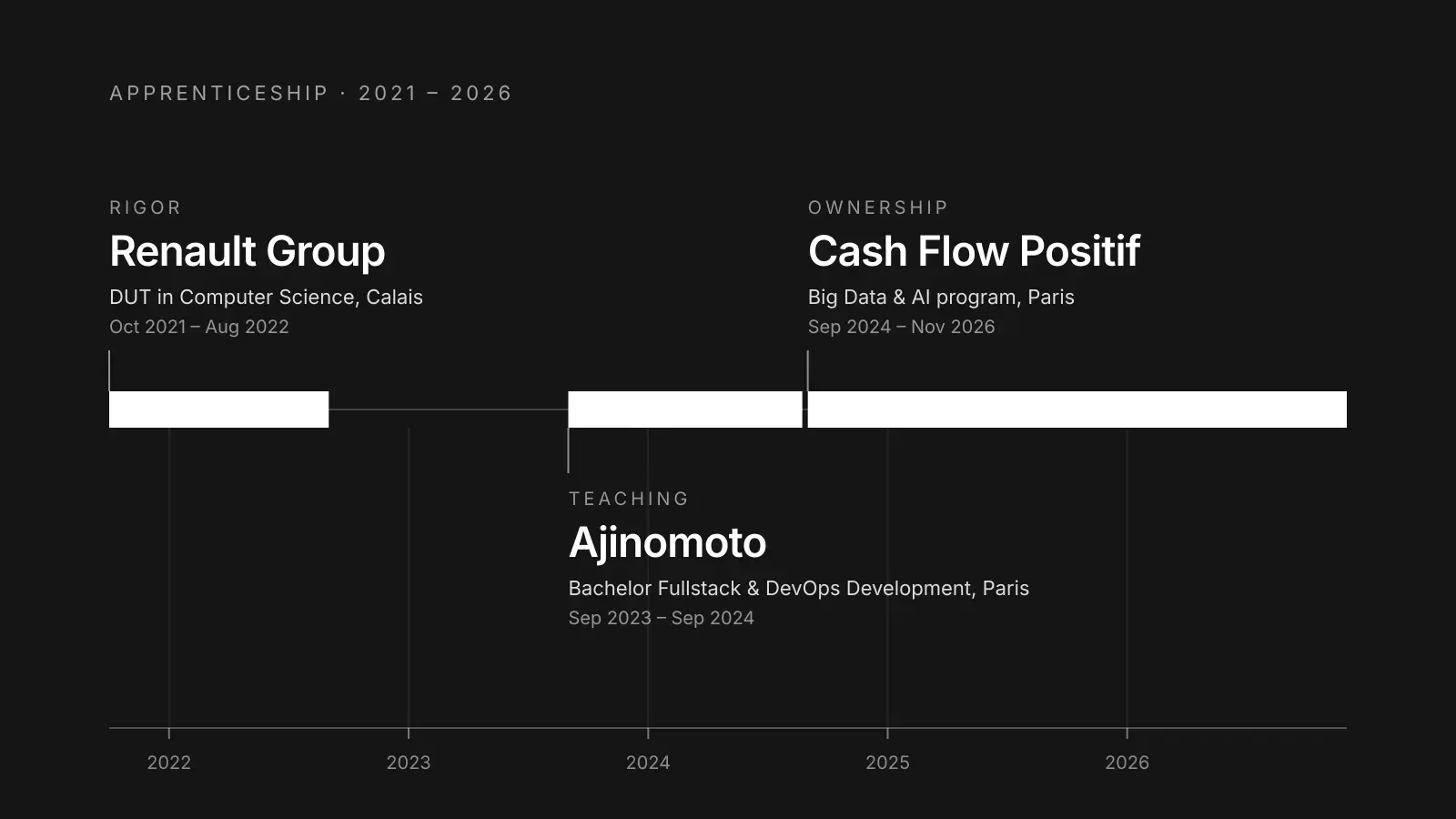
Between 2021 and 2026, I did my apprenticeship in three very different companies: a global industrial group, a mid-sized industrial company and a small startup. Each one changed the way I work.
In short:
- Renault Group taught me rigor.
- Ajinomoto taught me to teach and adapt.
- Cash Flow Positif taught me to own a product from end to end.
Renault Group: rigor comes first
- Period: October 2021 – August 2022
- Program: DUT in Computer Science, Université du Littoral Côte d'Opale (Calais)
- Tools: Spotfire, Looker, Google Cloud Platform (GCP), Excel with VBA macros
- Key result: 80% less time to produce breakdown reports
It was my first professional experience, and it left a strong impression. I was impressed by the factory and all the machines running. I was also surprised by how much trust I was given from the start.
What I worked on
I built two kinds of dashboards:
- KPI dashboards at different scales: daily, weekly and monthly, depending on who needed the numbers.
- A production line dashboard: which machines break down, what the failures are, how long repairs take, and how long a line stays stopped.
I used Spotfire or Looker depending on the needs and the kind of visualization. The data came from tables stored on GCP, or from Excel files processed with VBA macros.
By automating the follow-up through a GCP dashboard, I reduced the time needed to produce breakdown reports by 80%.
Learning to proofread my own work
At the beginning, I tended not to proofread what I delivered. My apprenticeship tutor had to go back over it every time.
Little by little, he reviewed less and less, and I became more autonomous. By the end, he only stepped in on rare occasions.
The day I almost arrived late
I lived far from the site: 1h20 each way, every day. One day, a mechanical problem with my car meant I was going to be late, and I was dreading it.
In the end, simply warning my tutor beforehand was enough. Everything went fine.
The lesson: rigor starts with simple things, like being on time and delivering what is expected. Proofreading your own work and warning people early when something goes wrong both build trust, and trust is what gives you autonomy.
Ajinomoto: teaching people is part of the job
- Period: September 2023 – September 2024
- Program: Bachelor in Fullstack & DevOps Development, IPSSI (Paris)
- Tools: ShareGate, Excel, Power Automate, SharePoint and Microsoft 365
- Key result: 370,000 files migrated to Microsoft 365, across 14 SharePoint sites
Ajinomoto is smaller than Renault Group, but it is still spread across several sites and still industrial.
The mission
This time, the mission was much bigger and less one-off: a document migration, so that employees would use the cloud instead of on-premise servers.
I coordinated the migration of 370,000 files to Microsoft 365, spread over 14 SharePoint sites. I also structured the document spaces to make them easier to access. I used ShareGate with Excel, and Power Automate to automate some of the tasks.
The human side
The technical side was only half of the job. The other half was people. I learned to:
- Train users and explain a new way of working.
- Be a force of proposal: show what works and what works less well, instead of waiting to be told.
- Adapt to each person, because not everyone uses their tools the same way.
The phones that kept ringing
I remember one training session where some colleagues kept getting phone calls, again and again. It became unbearable.
I told them to switch their phones off if they really wanted to be effective, otherwise there was no point in coming. They did, and the rest went very well.
The lesson: a migration is not successful when the files are moved. It is successful when people actually use the new tool, and sometimes that means being clear about what you expect from them.
Cash Flow Positif: owning a product from A to Z
- Period: September 2024 – November 2026
- Program: Big Data & AI, IPSSI (Paris)
- Tools: React, Fastify, Prisma, Symfony
- Key result: a showcase website for the 1,000+ properties managed by the company
Cash Flow Positif is a much smaller company, a startup. Here, I was completely autonomous.
The platform
My mission was to build a platform for property management, covering:
- Lead management.
- Scheduling visits.
- Handling applications from prospective tenants.
I also designed and launched a showcase website to promote the more than 1,000 properties managed by the company.
On the technical side, I mostly worked with React, Fastify and Prisma, and with Symfony for the web application.
Understanding the whole chain
To build it properly, I had to understand the whole chain, from A to Z.
It starts with the trust an owner needs in order to hand over their property. It goes all the way to supporting the search for a tenant, and making sure that, once the tenant has moved in, there are no problems.
The stress of going to production
Will everything work as it did in development? Will a last-minute problem force us to postpone something?
There is always some stress, even when you have run a beta and put tests in place. You can anticipate edge cases, but never enough of them.
That feeling never really goes away, but you learn to live with it.
The lesson: understanding the business changes the way you build. You stop just implementing screens and start solving real problems for the people on both sides, the owner and the tenant.
What I would do differently
- Proofread from day one. It took me a while to take the habit, and it cost my tutor time that he could have spent elsewhere. Now I check my work before handing it in, systematically.
- Communicate sooner. I lost sleep over a delay that one message could solve.
- Ask more questions to understand the need. Making the effort to ask upfront means you don't build a feature that doesn't fit the requirements.
Advice if you are starting an apprenticeship
- Be reliable on the basics: be on time, deliver what is expected, check your work before sending it.
- Warn early when something goes wrong. People understand problems, not silence.
- Use feedback to need fewer corrections over time. That is how you earn autonomy.
- Learn how the people who use your work think, and adapt to them.
- Understand the business, not only the code.
- Take the trust you are given seriously. It is often greater than you expect.
Conclusion
Three companies, three sizes, three lessons: rigor, teaching, and ownership.
If you want to see what I build today, have a look at my projects, or send me an email.